
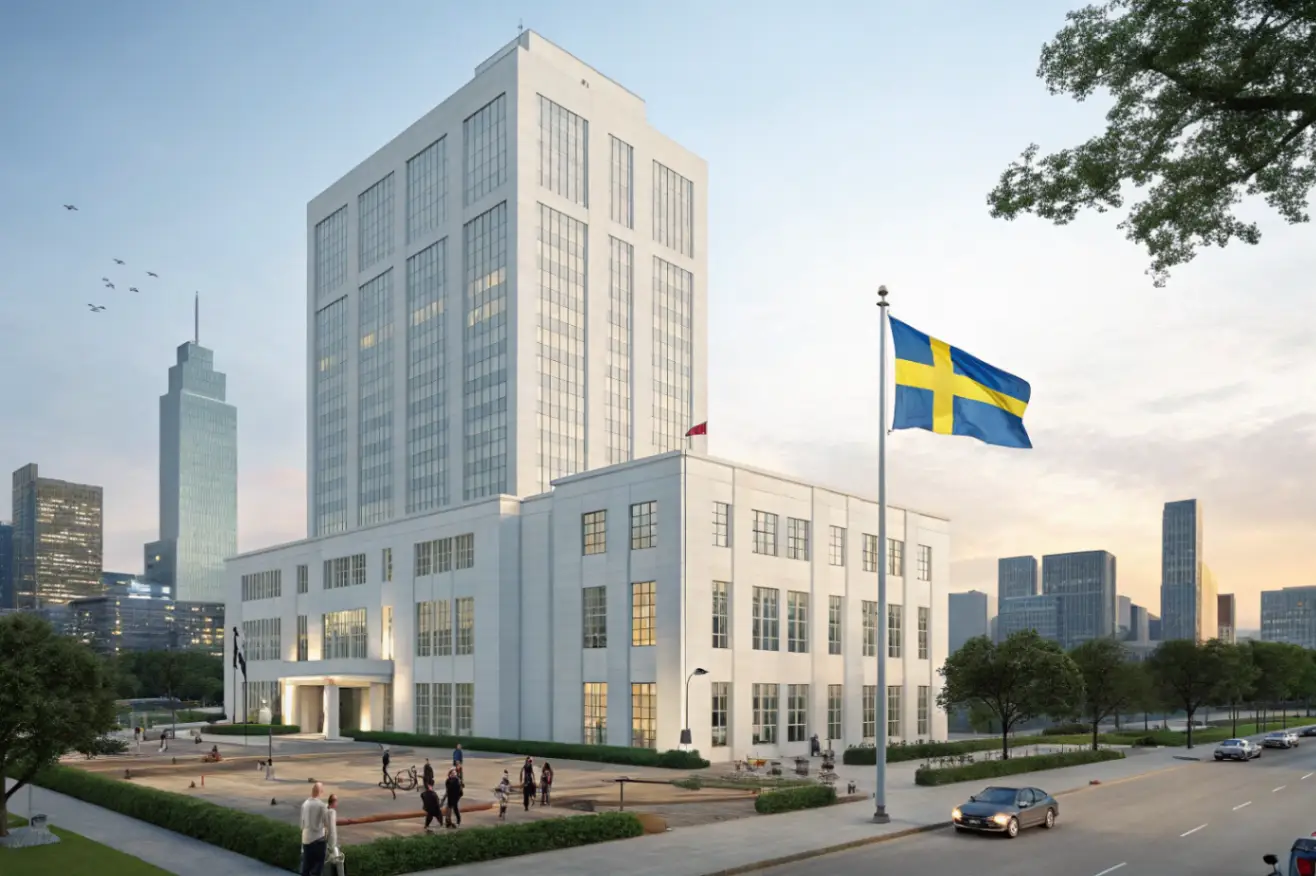
In 2026, Sweden is taking a decisive step to deepen its economic partnership with the United States through the active promotion of its new consulate in Houston, Texas. As global trade patterns shift and innovation becomes the primary driver of growth, diplomatic infrastructure is increasingly tied to economic strategy. The Swedish Embassy in the United States has positioned the Houston consulate as a strategic hub for Swedish–American economic cooperation, with a particular focus on energy, advanced technology, life sciences, and sustainable development.
Houston, long recognized as the energy capital of the world and an expanding center for medical research and technology startups, offers a powerful platform for Swedish companies seeking access to U.S. markets. The opening and expansion of Sweden’s diplomatic presence in Texas reflects a broader vision: to strengthen bilateral trade, promote investment flows, and accelerate collaboration in high-growth industries that define the future economy.
Strategic Importance of Houston for Swedish–American Economic Relations
Houston represents far more than a geographic expansion of Sweden’s diplomatic footprint. It symbolizes a strategic alignment between Swedish innovation and American industrial strength. Texas is one of the largest economies in the world if measured independently, and Houston stands at the intersection of energy transformation, healthcare innovation, aerospace, and digital infrastructure.
For Sweden, whose economy is deeply export-oriented and innovation-driven, proximity to such a dynamic regional market provides tangible advantages. Swedish companies in renewable energy, electrification, smart grids, biotechnology, and medical devices increasingly require local representation to navigate regulatory frameworks, establish partnerships, and secure investment capital. The consulate in Houston answers this need directly.
Economic cooperation between Sweden and the United States has historically been strong, supported by long-standing trade agreements, cultural ties, and shared commitments to sustainability and technological leadership. However, the complexity of today’s global supply chains and the competitiveness of American markets require more targeted diplomatic engagement. By strengthening its presence in Houston, Sweden ensures that its businesses are not only visible but strategically positioned.
The consulate functions as a bridge between Swedish enterprises and American stakeholders, including state authorities, research institutions, venture capital networks, and industry associations. It also facilitates high-level business delegations, policy dialogues, and innovation exchanges that would be more difficult to coordinate from Washington alone. In this way, the Houston consulate enhances Sweden–U.S. trade relations through direct regional engagement.
Key Sectors Driving Bilateral Trade and Investment
The new Swedish consulate in Houston prioritizes sectors where Sweden and the United States share complementary strengths. These industries are central to future economic growth and offer significant opportunities for cross-border collaboration.
Before examining individual initiatives, it is useful to outline the main focus areas shaping Swedish–American economic cooperation in Texas:
| Sector | Swedish Strengths | U.S. (Houston/Texas) Advantages | Cooperation Potential |
|---|---|---|---|
| Renewable Energy | Wind power, battery tech, grid solutions | Oil & gas transition, hydrogen hubs | Energy transition partnerships |
| Advanced Technology | AI, IoT, fintech, cybersecurity | Large tech ecosystem, venture capital | Joint R&D and startup expansion |
| Life Sciences & Medicine | Biotech, medical devices, digital health | Texas Medical Center, research hospitals | Clinical trials and medtech scaling |
| Sustainable Infrastructure | Smart cities, green construction | Rapid urban growth | Urban sustainability projects |
| Aerospace & Innovation | Satellite tech, engineering | NASA Johnson Space Center | Space-tech cooperation |
These sectors reflect the alignment between Sweden’s export-driven innovation economy and Houston’s industrial and research capacity. The energy transition stands out as particularly significant. As global demand shifts toward cleaner and more sustainable energy systems, Swedish expertise in electrification, offshore wind, hydrogen technology, and carbon reduction aligns closely with Texas’s evolving energy landscape.
The Texas Medical Center, the largest medical complex in the world, offers immense potential for collaboration with Swedish life sciences firms. Joint research programs, clinical testing partnerships, and commercialization of medical technologies are likely to increase under the coordination of the consulate.
By concentrating resources on these high-impact industries, the Swedish consulate in Houston strengthens bilateral investment flows and encourages long-term industrial partnerships rather than short-term trade exchanges.
Core Functions of the Swedish Consulate in Houston
Beyond symbolic diplomacy, the consulate’s role is operational and business-focused. Its mandate extends into direct economic facilitation, investment promotion, and policy coordination. To understand its practical impact, it is important to outline its primary functions within the framework of Sweden–U.S. economic cooperation.
The core activities of the Swedish consulate include:
- Supporting Swedish companies entering or expanding in the U.S. market.
- Facilitating trade missions and high-level business delegations.
- Connecting Swedish startups with American investors and incubators.
- Promoting sustainable energy partnerships and climate initiatives.
- Assisting with regulatory navigation and local compliance.
- Strengthening academic and research collaboration.
Each of these functions contributes to reducing barriers for Swedish enterprises seeking to operate in Texas and across the southern United States. Market entry in the U.S. can be complex due to state-level regulations, tax structures, and sector-specific compliance requirements. The consulate provides strategic guidance, helping businesses minimize risk and accelerate expansion.
Additionally, innovation ecosystems thrive on connectivity. By linking Swedish technology firms with Houston’s startup accelerators, venture capital funds, and corporate innovation hubs, the consulate plays a catalytic role. Its engagement is particularly important in emerging sectors such as hydrogen energy, digital health, and advanced manufacturing.
The consulate also enhances institutional cooperation. Partnerships between Swedish universities and Texas research institutions foster knowledge exchange and workforce development. In the long term, these collaborations contribute to sustainable economic growth and deeper bilateral integration.
Energy Transition and Sustainability as Central Pillars
Energy cooperation lies at the heart of the Swedish consulate’s mission in Houston. Historically known for oil and gas production, Texas is now positioning itself as a global leader in renewable energy, hydrogen development, and carbon management. Sweden’s expertise in clean technology makes it a natural partner in this transformation.
Swedish companies have pioneered solutions in wind power, battery storage, electrified transportation, and smart energy grids. These capabilities align with Texas’s growing investments in renewable infrastructure and hydrogen hubs. By facilitating partnerships between Swedish cleantech firms and Texan energy companies, the consulate accelerates joint ventures that advance the global energy transition.
Sustainability extends beyond energy production. Urban growth in Houston creates demand for smart city solutions, efficient public transport systems, and climate-resilient infrastructure. Swedish firms specializing in green construction materials, sustainable architecture, and digital urban planning tools find promising opportunities in this environment.
Moreover, U.S.–Sweden climate cooperation supports broader geopolitical objectives. Both nations advocate for emissions reduction, technological innovation, and resilient supply chains. The Houston consulate becomes a practical mechanism for translating these shared policy goals into commercial reality.
By anchoring economic diplomacy in sustainability, Sweden strengthens its reputation as a leader in green innovation while contributing to American efforts to modernize industrial systems.
Innovation, Technology, and Medical Collaboration
Beyond energy, the Swedish consulate in Houston focuses on strengthening cooperation in advanced technology and life sciences. Sweden consistently ranks among the world’s most innovative economies, with globally recognized companies in telecommunications, fintech, biotech, and digital solutions.
Houston’s expanding tech ecosystem provides fertile ground for Swedish startups. Venture capital networks, corporate innovation labs, and research institutions actively seek international collaboration. The consulate plays a matchmaking role, ensuring Swedish companies can integrate into local innovation clusters efficiently.
The Texas Medical Center represents a particularly strategic opportunity. As the largest medical complex in the world, it hosts hospitals, research institutions, and biotech firms engaged in cutting-edge clinical trials and translational research. Swedish medical device manufacturers and biotech startups benefit from direct access to this ecosystem.
Collaboration in digital health, AI-driven diagnostics, and precision medicine is expected to expand significantly. Swedish strengths in patient-centered healthcare technology complement the scale and research infrastructure of American medical institutions.
In aerospace and advanced engineering, proximity to NASA’s Johnson Space Center further enhances potential partnerships. Swedish space-technology firms and engineering companies can leverage this regional advantage to expand transatlantic cooperation.
The integration of technology, medicine, and innovation under the guidance of the Houston consulate ensures that bilateral relations move beyond traditional trade into high-value knowledge exchange.
Long-Term Impact on Sweden–U.S. Economic Partnership
The establishment and active promotion of the Swedish consulate in Houston in 2026 marks more than a diplomatic milestone; it signals a long-term strategic commitment to regional economic engagement in the United States.
Decentralized diplomacy allows Sweden to operate closer to economic growth centers rather than relying solely on federal-level coordination in Washington. This regional approach aligns with how business decisions are made in the United States, where state and metropolitan economies often function independently.
Over time, the Houston consulate is expected to:
Strengthen bilateral trade volumes between Sweden and Texas.
Increase foreign direct investment flows in both directions.
Promote joint research and development initiatives.
Support sustainable industrial transformation.
Enhance resilience in transatlantic supply chains.
The impact will likely extend beyond Texas. Successful partnerships formed in Houston can scale nationally, influencing broader U.S.–Sweden economic relations. As global competition intensifies, proactive diplomatic engagement becomes essential for maintaining competitive advantage.
By investing in regional diplomatic infrastructure, Sweden demonstrates a forward-looking approach to economic cooperation. The Houston consulate serves as a gateway not only to Texas but to a rapidly evolving American innovation landscape.
Conclusion
The new Swedish consulate in Houston represents a strategic expansion of Sweden’s economic diplomacy in the United States. Positioned at the crossroads of energy transformation, medical innovation, and technological development, Houston offers unmatched opportunities for bilateral growth.
Through targeted support for Swedish companies, promotion of sustainable partnerships, and facilitation of innovation collaboration, the consulate strengthens Swedish–American economic cooperation in 2026 and beyond. This initiative reflects a broader understanding that modern diplomacy must actively enable trade, investment, and technological exchange.